AI and Claude for agencies
AI 101: What Insurance Agencies Actually Need to Know
A no-hype, practical guide for insurance agencies adopting AI. The difference between automation and AI, and how to mitigate compliance risk.

AI won’t replace agents, but agents who understand AI will replace those who don’t. What agencies actually need to know is the difference between automation, machine learning and generative AI, which workflows are proven today, and how to stay on the right side of compliance and E&O risk.
The adoption paradox
Independent agencies face a critical gap. While carriers are racing ahead with billion-dollar investments, most agencies are still on the sidelines. This gap represents both your biggest competitive risk and your biggest opportunity to differentiate.
| Insurers using AI | Agents using AI |
|---|---|
| 91% | 6% |
The reality: AI excels at defined tasks (documents, email) but fails at relationship judgment.
“AI will not replace human agents, but AI tools have the potential to save agents time… by streamlining routine administrative tasks.”
Agent for the Future (Liberty Mutual/Safeco)
What AI actually is (and what it isn’t)
The industry conflates three distinct technologies. Don’t let vendors confuse you.
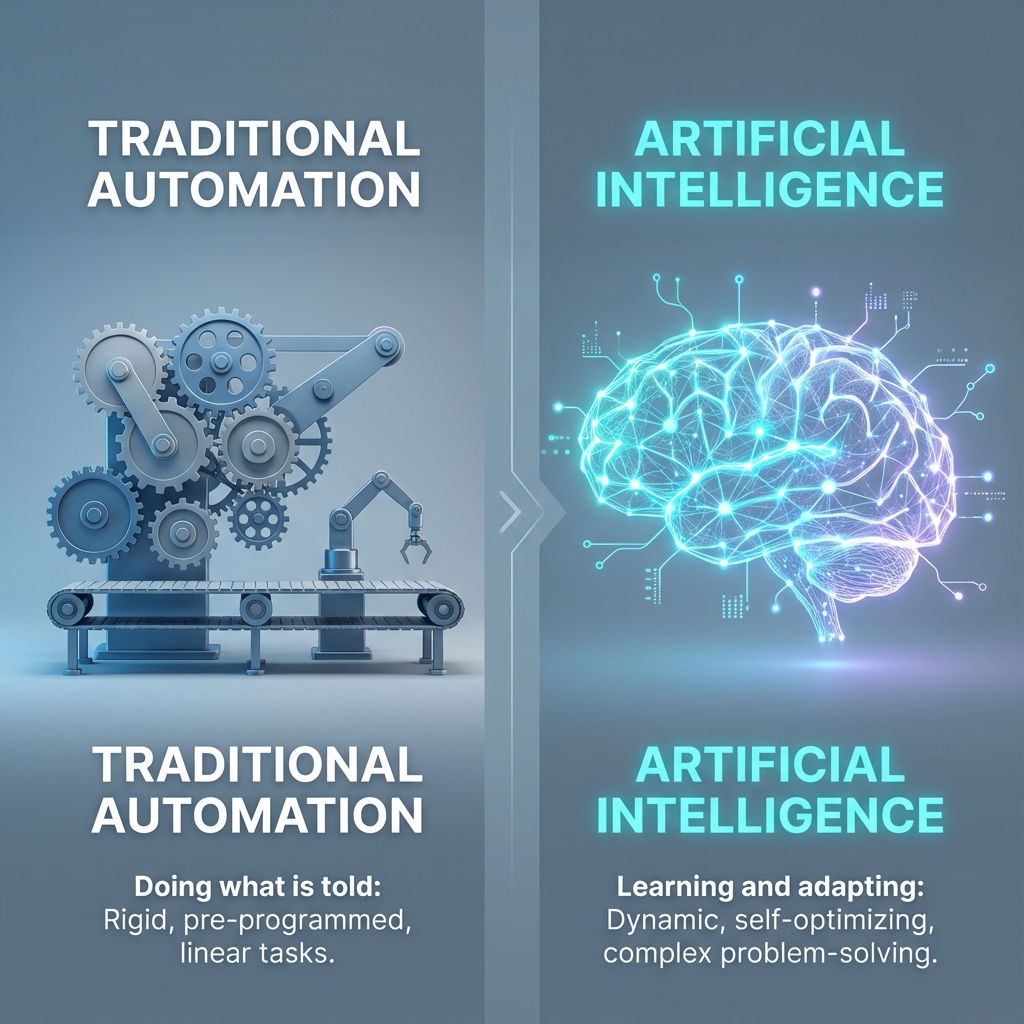
1. Traditional automation
“Doing what is told.” Rigid if-then rules. When a renewal date hits, send an email. No learning, no adaptation. This is your AMS workflow to-do list.
2. Artificial intelligence (ML)
“Learning and adapting.” Systems that analyze historical data to predict future outcomes. Example: “Clients with X characteristic are 40% more likely to lapse.”
3. Generative AI (LLMs)
“The Guessing Machine.” ChatGPT, Claude, Gemini. They excel at drafting text and summarizing, but because they are probabilistic, they can “hallucinate” (make up facts). Great for drafts, dangerous for final decisions. (See our guide on maintaining brand voice.)
Proven workflows and ROI
Document processing (most mature)
Automated extraction from ACORD forms, loss runs, and dec pages. Human review is still needed, but the heavy lifting is gone.
Real world stats:
- Roots AI: 98% accuracy on ACORD forms
- Archipelago: 75-90% time reduction on SOV/loss runs
Policy servicing (high impact)
Certificate issuance and FAQ chatbots. Resolving routine inquiries without producer intervention.
Real world stats:
- Certificate Hero: 90% reduction in mailed certs
- Zurich’s “Zuri”: 50% of inquiries resolved without calls
Retention analytics (strategic)
Predictive models identifying at-risk accounts before the renewal notice generates.
Real world stats:
- J.D. Power: 23% improvement in retention rates
- EZLynx Retention Center: identify price-increase churn risk
Lead qualification (speed)
AI scoring and routing to the right producer based on intent signals.
Real world stats:
- 80% faster response times
- 70% reduction in data gathering time
Risk and compliance
The NAIC Model Bulletin isn’t a suggestion. It’s the future of regulation. Half of U.S. states have already adopted it. For a full decision matrix, see our Strategic Evaluation Framework.
- Data privacy: Never enter PII into free tools. You are training their model with your client data.
- Human oversight: California SB 794 proposes requiring human sign-off for adverse decisions.
Your week 1 experiments (zero risk)
Experiment 01: Email drafting
Write a professional 30-day renewal reminder for an auto client emphasizing rate stability…
- Use ChatGPT Free
- No PII allowed
For more, see 5 Copy-Paste AI Prompts for Insurance Agencies.
Experiment 02: Doc summaries
[Paste Carrier Bulletin PDF]
Summarize the 3 key underwriting changes for my team meeting.
- Saves 30+ mins reading
- Great for team prep
Experiment 03: Meeting notes
Use Otter.ai (Free Tier) to record your Monday staff meeting.
- Auto-extract action items
- 100% accountability
Essential terminology
- Agentic AI: Systems that can take autonomous actions toward goals with minimal human intervention. Expected mainstream by 2026-2028.
- Hallucination: When AI generates plausible but false information. A fundamental, inescapable feature of probabilistic LLMs.
- NAIC Model Bulletin: Guidance establishing expectations for responsible AI use by insurers; adopted by nearly half of states.
- Predictive Analytics: Using historical data patterns to forecast future outcomes like customer churn or claims frequency.
- SOC 2 Type II: Security certification demonstrating sustained compliance with trust service criteria. Mandatory for any AI vendor you hire.
“Responsible adoption of AI is key. Speed to adopt should not be at the expense of thoughtful change. It is critical to balance innovation with empathy, governance and, most importantly, trust.”
Manu Mazumdar, Conning